From Disruption to Delivery: What It Really Takes to Turn Breakthroughs Into Access
This post was developed in collaboration with Global Development Interrupted and first published on their Substack.
In a follow-up to her Global Development Interrupted interview, Ashley Vij shares what it really takes to turn innovation into access.
Starting a nonprofit has been a wild ride.
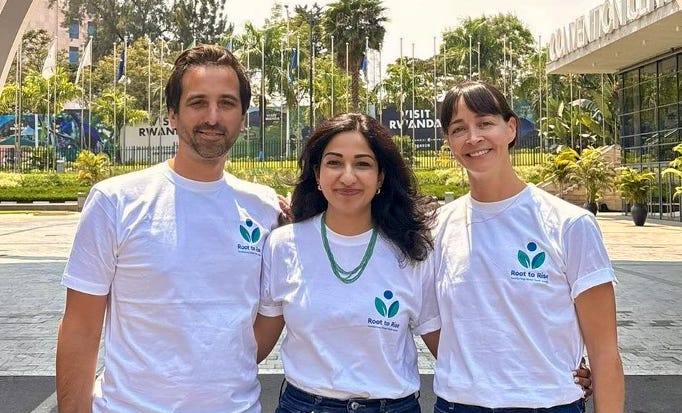
In July 2025, I started Root to Rise with Daniel Kiesa and Rose Wilcher, fellow global health champions with deep HIV expertise, whom I met through my decade of work in the Global Health Bureau of USAID. The organization is our labor of love, dedicated to transforming how lifesaving health products reach the people who need them most.
When we launched Root to Rise, we were met with a mix of encouragement and skepticism. People asked practical questions: Where will the funding come from? How are you going to find projects? And more existential ones: Isn’t global health basically done? Who’s going to trust an American NGO in this environment? Some suggested we skip the hard parts and “just go to pharma.”
I’m still not entirely sure what made us believe so deeply that we could keep supporting this work. Maybe it was stubbornness. Maybe hope. Maybe simply refusing to walk away from work we knew still mattered, still needed to go on.
That instinct to stay when things get uncomfortable is what brought Root to Rise into being. And it’s what’s keeping us here now.
When I spoke to Global Development Interrupted in October 2025 about the sudden worldwide dismantling of USAID support, I described how global HIV prevention efforts stalled almost overnight. That disruption didn’t happen in isolation. It landed right in the middle of planning for the introduction of one of the most promising HIV prevention tools we’ve seen in decades: Lenacapavir (LEN). LEN is a form of pre-exposure prophylaxis, or PrEP, a medication that prevents HIV infection when taken before potential exposure. What makes it different is that it’s injectable and only needed twice a year, an option that could meaningfully expand choice, especially for women and other communities that have long been underserved.
What worried me most in that moment wasn’t just the loss of funding or momentum. It was the very real possibility that, once again, a scientific breakthrough could fail to reach the people it was designed for.
Root to Rise works to bridge the gap between scientific approval and client access, between innovation and real life. We work at every stage of the process to support the introduction of new health products, focusing on the unglamorous but essential work that actually makes delivery possible: policy updates, coordination, community engagement, and readiness planning.
We’ve been fortunate to receive early support from the Gates Foundation, the Elton John AIDS Foundation, AVAC, and Wits RHI. That support has allowed us to start small, listen closely, and build intentionally. Nowhere is that more visible than in Nigeria.
What This Work Looks Like in Practice: Nigeria
The government of Nigeria recently approved LEN for HIV prevention, less than a year after WHO recommended LEN as an HIV prevention option. That alone is a big deal, and it didn’t happen by accident, as the Ministry of Health had been steadily diligent and forward-looking in preparing for this moment.
But approval is not the finish line. It’s the starting point.
Since our founding, Root to Rise has been working alongside national stakeholders in Nigeria to help prepare for the rollout of LEN, currently planned for early 2026. Our role has been less about promotion or publicity, and more about readiness - making sure systems, policies, and partnerships are actually set up to work once the product arrives in the country.
In practice, that has meant rolling up our sleeves and working closely with the Ministry of Health and its partners on things that make new health tools usable in the real world: aligning policies, ensuring supply needs are met, preparing services to receive clients, and helping communities understand what LEN does - and what it doesn’t do. And because we believe these lessons matter beyond one country, we’ve shared Nigeria’s experience at a global level as a case study with UNAIDS.
None of this is flashy. All of it matters.
We do this because better tools only change outcomes if health systems and communities are ready to use them.
Why Community Infrastructure and the Whole Ecosystem Matters
One of the clearest lessons we’ve learned, again and again, is that scientific innovation doesn’t succeed on its own. Trust, awareness, and real choice don’t magically appear once a product is approved. They have to be built, intentionally and over time.
For instance, Root to Rise is updating training materials for HIV prevention peer ambassadors, to teach communities about LEN before it becomes available. The need for this kind of infrastructure is easy to underestimate. But without it, even the most effective products risk sitting unused, misunderstood, or mistrusted.
With that same intent, Root to Rise also helped bring together ten civil society organizations (CSO) to form Nigeria’s first National CSO Coalition on PrEP. Before this, community voices were often fragmented. They were brought in late, or asked to respond to plans rather than help shape them. That’s changed. Now that the coalition is nationally recognized, it’s created a respected space for community-based advocacy, coordination, and monitoring, where concerns surface earlier and communities are no longer an afterthought.
This is careful work. And it’s happening in the middle of real uncertainty, in an HIV prevention landscape that is already stretched thin - where introducing something new like LEN often means also strengthening what’s already in place.
Holding the Line
So much of last year was devastating. So much support was lost for global health, and especially for HIV prevention. And I’ve seen time and time again, with both USAID and Root to Rise, that disruption doesn’t end when funding stabilizes - it lingers in systems, relationships, and trust. Translating innovation into access requires sustained investment, realistic planning, and patience with the messy middle.
In Nigeria, Root to Rise showed up in small but meaningful ways - helping finish policies, form a coalition, and shape a blueprint. None of it is enough on its own. But together, it keeps the door open for more critical public health programming.
As we look ahead, I’m holding onto the possibility that the coming year brings more global steadiness and more clarity. Nigeria’s progress shows what’s possible when governments prepare early and partners stay engaged. But this is not the moment to let our guard down.
At Root to Rise, we exist to hold that line, so that even in moments of disruption, lifesaving innovations remain within reach.