It's Called Math!

Daniel Kiesa
My kids love playing a card game called Sleeping Queens. Among the gameplay, you combine numbered cards into math equations, such as two cards adding up to a third. Playing with my family one day, I asked what was going on, and my daughter said, “It's called math, Dad.” It stuck, and now we hear it every time we play. It's also what I want to say to people when early deliveries during a product launch don't translate cleanly into how many users there are. It's called math!
First, we need to acknowledge that alongside the people who are clients of a new product, there's another customer: the storage shelf. Central warehouses, sub-national warehouses, hospitals, and clinics all need inventory on hand once a product is in use. Second, we should distinguish between two types of inventory. Cycle stock is what keeps operations moving, such as the inventory drawn down to hand to a customer. In contrast, buffer stock protects against the unexpected, like supply delays or demand swings, and can be minimized with precise planning. Cycle stock is necessary to function; buffer stock is a smart hedge. During a product introduction, cycle stock has to be built into the supply chain before the product can even be available on shelves for use, which means early deliveries aren't all going immediately to clients.
Let's do the math, using some typical assumptions. In global health, it can take about three months for a batch to move from import into a country to being consumed by a client. So we'll assume the national supply chain needs three months of cycle stock. Start with 1,000 clients in month one and hold that number steady month-over-month. The steady-state need is 1,000 units per month, but the first month requires more, in order to build the cycle stock. Without this stock, product would be depleted as soon as it reaches the point of care. Patients would not be able to rely on available supply. The table below illustrates:
Jan | Feb | Mar | Apr | May | Jun | |
Clients | 1,000 | 1,000 | 1,000 | 1,000 | 1,000 | 1,000 |
Cycle Stock Target | 3,000 | 3,000 | 3,000 | 3,000 | 3,000 | 3,000 |
New Deliveries Required | 4,000 | 1,000 | 1,000 | 1,000 | 1,000 | 1,000 |
New delivery requirements reflect the number of clients consuming the product and the growth in the cycle stock.
The dynamic gets more complex if the client base grows month over month:
Jan | Feb | Mar | Apr | May | Jun | |
Clients | 1,000 | 2,000 | 3,000 | 4,000 | 5,000 | 6,000 |
Cycle Stock Target | 3,000 | 6,000 | 9,000 | 12,000 | 15,000 | 18,000 |
New Deliveries Required | 4,000 | 5,000 | 6,000 | 7,000 | 8,000 | 9,000 |
The need for additional cycle stock continues as long as the client base keeps growing. Here's what's actually driving those new delivery requirements:
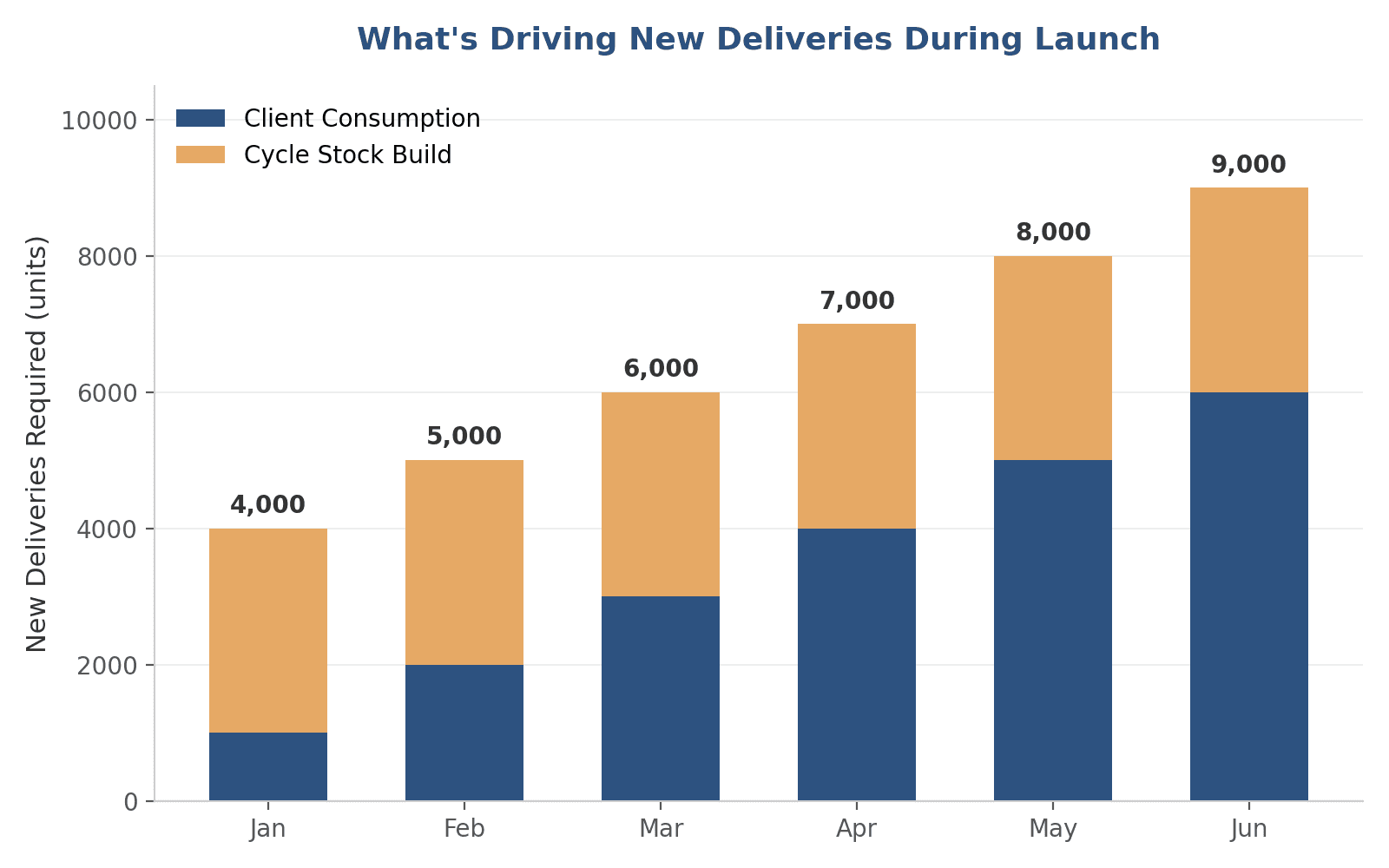
Cycle stock's share of new deliveries is highest early in a rollout and shrinks over time, as growth becomes a smaller fraction of the base. In this scenario, total deliveries over six months were 39,000 units, and 18,000 of them, or 46%, support cycle stock, not client consumption.
The same math applies to buffer stock, and it's often the bigger piece. National supply chains typically run on a min-max policy set somewhere between six and twelve months of stock on hand, and of that, about three months is the cycle stock described above. The rest (three to nine months depending on the product and country) is buffer: stock held in case a shipment is late, a forecast misses, or logistics are disrupted. As the client base grows, that buffer has to be built too, following the same logic as cycle stock. Buffer stock shows up in delivery totals the same way that cycle stock does, and because it can be two to three times the size of cycle stock, it can distort those totals even more. Some of that buffer may not be strictly necessary in modern systems, but that’s an analysis for another day.
Before reading a delivery number as a proxy for client reach, it's worth considering how much of it is still filling the pipe. The math compounds further once you add multi-month dispensing, where a single delivery covers several months of a client's supply at once. But the principle holds regardless: when the numbers don't seem to add up, check the supply chain math before assuming something's wrong. It's called math, Dad.